So we are sitting in the Paro airport, reputedly the trickiest airport in the world for landing and departing, though we’ve seen a few planes swoop in and they seem to have no trouble with that last bank and then the landing. It is sunny, and a long journey home awaits, and it is a good time to try to capture some random and disorganized and sometimes fleeting impressions of a month in India and Bhutan.
India started in Kolkata, which felt like the other two huge Indian cities (Delhi and Mumbai) except without some of the polish.
The rest of the parts of India we visited – the Himalayan foothills of the Darjeeling region of West Bengal and the state of Sikkim – felt like no part of India we have seen before. Maybe it’s the topography, maybe it’s the relative lack of people, though the major towns are just as jammed up with traffic and teeming with activity as towns elsewhere. Maybe the people – largely Nepalese and Tibetan by origin, which reflects the fact that parts of the area were pried loose from the then kingdom of Sikkim and the state of Bhutan by the British, and the fact that historically these areas were oriented toward the north, not the south. The disdain with which our Darjeeling guide – ethnically Nepalese though an Indian citizen by birth – referred to “Indian” tourists confused us at first until we appreciated that he felt no Kinship with his fellow Indians from further south.
The economy in that part of India rests on two Ts – tourism and tea, which are not unconnected to each other. A certain fetishism is possible around tea, we came to understand, as our Darjeeling guide ordered tea for us as we arrived at each vaguely colonial hotel and then schooled us on what variation of Darjeeling tea it was (first flush, second flush, etc) and how to drink it. He travelled with his own stash and a little thermos for making it, not trusting the places we stayed, especially as we travelled close to Assam (tea only drinkable as chai, he said, an insult only slightly milder than calling it the dust fit only for tea bags). But climate change is coming. The rainy season is shifting and becoming less predictable, and the temperature is increasing, both of which are messing up the long Term prospects for tea in this area.
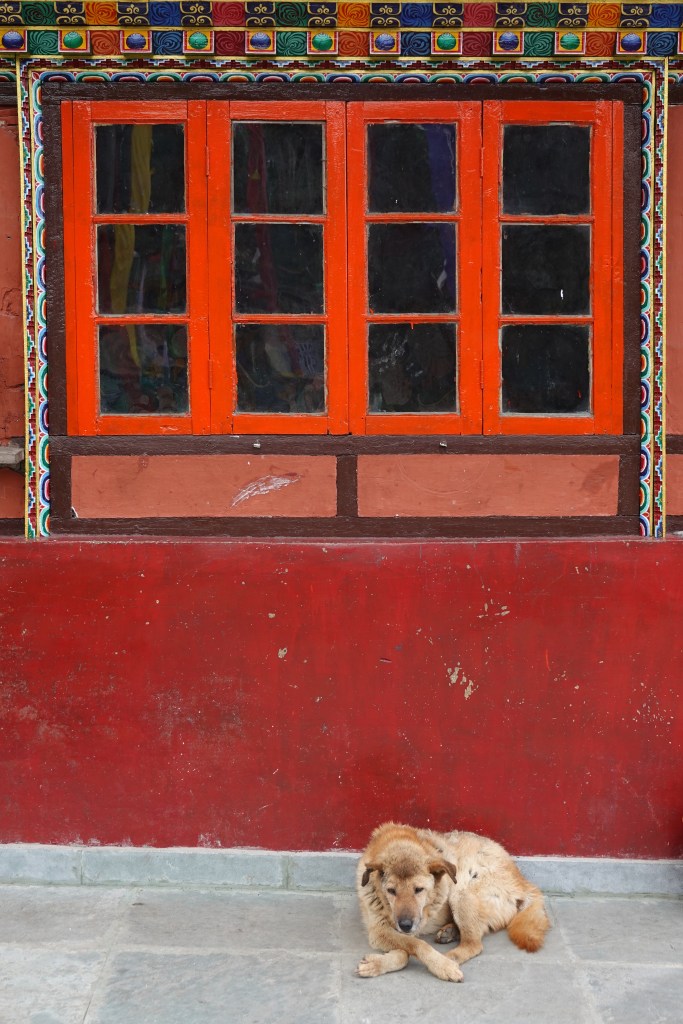
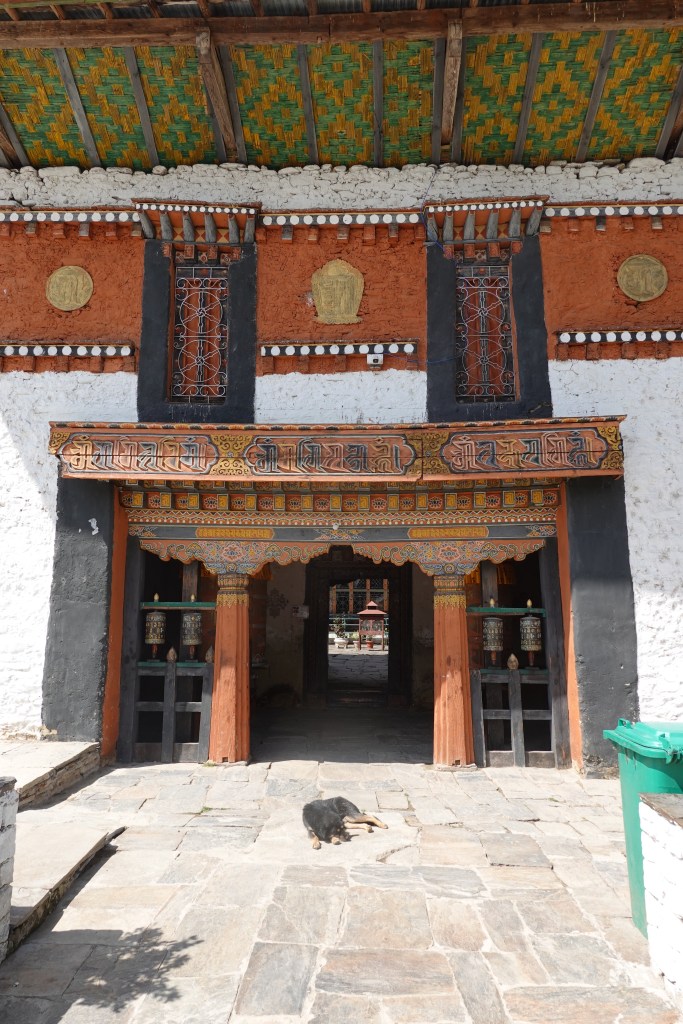
Dogs. Dogs are everywhere in this part of India and in Bhutan. Mostly they lie around on roads and especially in the sunny courtyards and forecourts of the temples. Once in a while a couple of them will trot briskly down the road with slightly anticipatory looks on their faces and looking for all the world like they are on their way to an appointment of some kind. They are apparently largely communally cared for, and seem happy with the arrangement. The pictures above are India and Bhutan respectively.
Bhutan, for its part, does not feel like India, not even Sikkim/Darjeeling. It is far less populated, for. One thing, with only about 700,000 people, and the roads are both better than the Indian mountain roads and a lot less crowded. It is a quiet place. – one comes for the scenery and the hiking, and the dzongs and temples. Except for the much higher altitude, and the much steeper valleys, it felt at times a bit like being in the Rockies and the decor sometimes looked a bit alpine.
And the King is everywhere. Not just in public spaces, but also in every restaurant and hotel and even in every temple there are colour pictures of the king alone, with his wife, with his wife and baby boy, with his father, who abdicated in his favour, with his whole family, often a variety of pictures in the same room. It’s a constitutional monarchy now, though the king has to approve laws and is the court of last resort. It’s hard too get a real feel for how he is seen by the general population, but he is referred to as the People’s King and our guide was super respectful so perhaps it is working here.
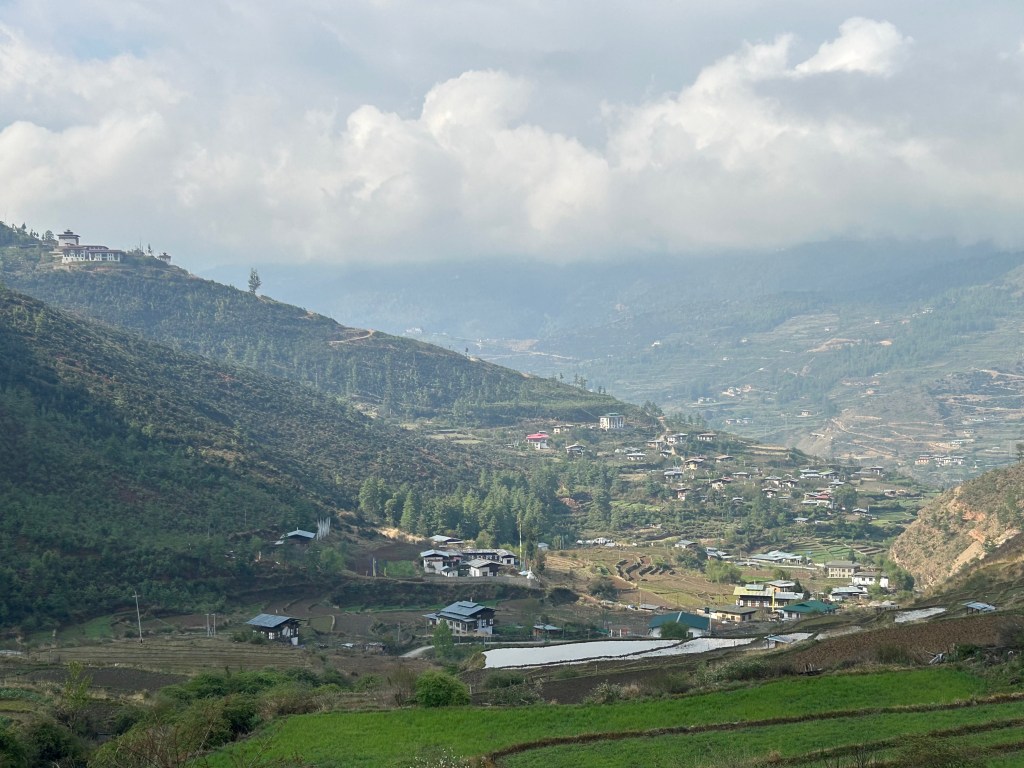
And that’s a wrap. Our final view of Bhutan, from our Paro hotel, closes this out
 bengalbhutanblog.ca
Leave a comment